What Liquor Is in a Carajillo? Brandy, Rum, Licor 43 and More
The cover is an illustration generated with artificial intelligence.
A carajillo has no single liquor. The traditional hot recipe usually contains brandy or rum. Licor 43’s iced recipe, which the brand calls its most popular drink in Mexico, uses that liqueur. Carajillos are also made with whisky, gin, anise, cognac or tequila. Every version shares coffee and an alcoholic drink.
Three quick answers:
- Rum and brandy are the most common spirits in the hot version.
- The iced Carajillo 43 recipe uses Licor 43, a sweet liqueur.
- Every carajillo contains alcohol, including the burnt carajillo.
Our guide What Is a Carajillo? explains the drink in full.
Rum and Brandy: The Classics of the Hot Carajillo
The Royal Spanish Academy (RAE) defines a carajillo as hot coffee with an alcoholic drink, generally a high-proof one. Brandy and rum are the usual choices. The 2025 guide to Castellón’s Ruta del Carajillo sums up its range as running “from the classic with rum or brandy to preparations with different liqueurs” (our translation).
The route is an initiative of the municipal tourism board of Castellón, Spain, and its guide describes 80 carajillos from 80 venues. We counted the drink names that appear literally in each description:
| Alcoholic drink | Descriptions that mention it (of 80) |
|---|---|
| Rum | 53, almost always burnt |
| Cognac or brandy | 8, plus 2 with Terry, a brandy brand |
| Whisky | 5 |
| Gin | 3 |
| Tequila | 2 |
| Licor 43 | 2 |
| Anise | 1 |
| Coffee liqueur or coffee cream liqueur, as an addition | 10 |
| Others: orujo, Cointreau, Marie Brizard, Baileys and other liqueurs | 1 or 2 each |
NOCTURNE’s count of the 2025 guide. Some recipes combine two drinks, such as cognac and rum or rum with coffee liqueur, so the rows do not add up to 80.
The rum in Castellón is almost always served burnt. It is flambéed with sugar, lemon peel, cinnamon or coffee beans and finished with coffee. The count describes one city’s route, and other cities and bars have their own habits.
Licor 43 in the Iced Carajillo
The official Carajillo 43 recipe shakes 50 ml of Licor 43 Original with a hot espresso and ice, then strains the mix into a glass full of ice. The brand calls it its most popular drink in Mexico.
Licor 43 is a liqueur, and the Licor 43 Original page describes a recipe of 43 ingredients with citrus, botanical and floral notes and a sweet palate with hints of vanilla. This version therefore tends to taste sweeter than an unsweetened brandy or rum carajillo.
Read Is a Carajillo Hot or Cold? for a side-by-side comparison of both versions.
Whisky, Gin, Cognac, Tequila and Anise
A carajillo works with other spirits too. The Castellón guide includes burnt whisky carajillos, one with smoked whisky finished with espresso, several with cognac on its own or mixed with rum, three with gin, two with tequila and one with anise. It also lists a carajillo made with Cointreau, an orange liqueur.
Each drink changes the carajillo’s profile, and the menu or bar staff can tell you which one they use. Ask which liquor it contains and whether it is served hot or over ice if the menu only says “carajillo”.
How Much Alcohol Each Option Has
A carajillo’s strength depends on the drink chosen and the amount served. For reference, Regulation (EU) 2019/787, in its consolidated version of 13 May 2024, sets the minimum strength these drinks need to be sold under those names in the European Union:
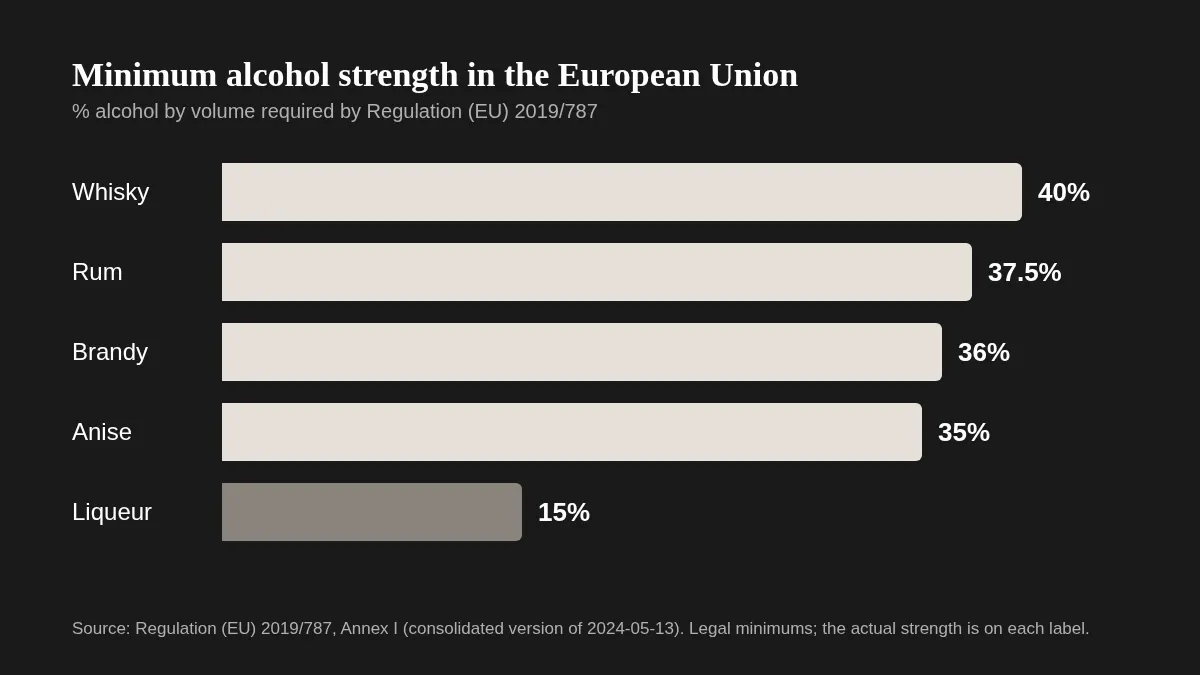
Source: Regulation (EU) 2019/787, Annex I, categories 1, 2, 5, 28 and 33. These are legal minimums; the actual strength is on each bottle’s label.
Whisky needs at least 40%, rum 37.5%, brandy 36%, anise 35% and liqueur 15%.
The clearest gap lies between spirits and liqueurs. A brandy, rum or whisky has at least 36% alcohol by volume, and the liqueur category starts at 15%. Other rules apply outside the European Union, so the bottle’s label is the final reference.
Does a Carajillo Have Alcohol?
Yes. Every carajillo contains an alcoholic drink, and heating or flaming it removes only part of the alcohol.
The USDA Table of Nutrient Retention Factors, Release 6 (2007) draws on an analytical study of alcohol in food preparation (Augustin and colleagues, 1992). The table gives 85% retention for alcohol stirred into a hot liquid and 75% for flamed alcohol. Most of the alcohol in a burnt carajillo therefore stays in the cup.
Here is an example with those figures. A 30 ml measure of rum at 37.5% holds about 11 ml of alcohol (30 × 0.375 = 11.25). About 9.6 ml remains (85%) if the rum is stirred into hot coffee, and about 8.4 ml remains (75%) if it is flambéed. The 30 ml measure is only an example; each bar pours its own, and the bottle’s actual strength changes the result.
How to Check What Is in a Ready-to-Drink Carajillo
A ready-to-drink carajillo comes prepared, and its label states its strength and ingredients. Check the alcohol by volume and the container size before you choose. Our guide to the NOCTURNE perfect serve explains how to serve NOCTURNE in a coupe, over ice or straight from the can.
Learn more about NOCTURNE Carajillo. This content is intended for adults.
NOCTURNE publishes this guide using sources from the RAE, consulted on September 23, 2026, and from Licor 43, Castellón’s Ruta del Carajillo, Regulation (EU) 2019/787 and the USDA, consulted on November 7, 2026. You can send questions or corrections through our contact form.